

Ahead of Holiday Gifting Season, New Report Finds Children Need Smartphone Skills Before Getting Access
News originally published by
EIN Presswire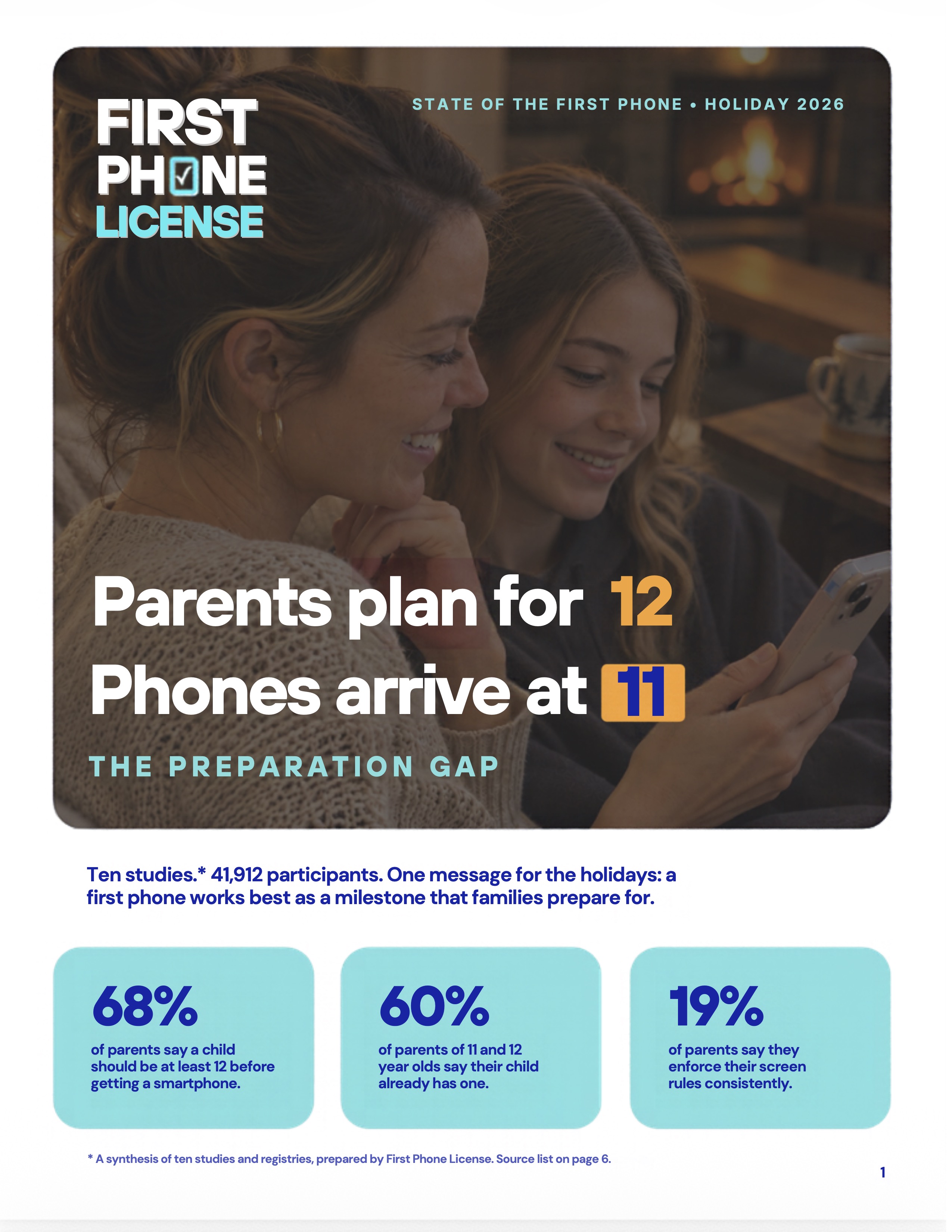
Preparation Gap Report
First Phone License releases analysis of 10 landmark studies spanning 41,000+ participants to guide parents through the "first phone" milestone.
Nobody hands a 16-year-old car keys and just hopes for the best. A smartphone is an open door to the world, and it requires the same educational framework.”
PLANO, TX, UNITED STATES, November 17, 2026 /EINPresswire.com/ -- As millions of families weigh whether to put a first smartphone under the tree this holiday season, First Phone License today released The Preparation Gap: State of the First Phone 2026. The report synthesizes 10 major academic studies, nationally representative surveys, and long-term cohort datasets encompassing 41,912 parents, children, teens, and young adults.— Dr. Bobo Blankson, Chief Medical Officer of First Phone License.
The report’s core conclusion: while nearly all parents approach the milestone with good intentions, common interventions such as written contracts and safety lectures do not change children’s behavior. Behavioral trials instead point to hands-on scenario practice as the approach with the strongest evidence for improving real-world digital habits.
Key Findings
- Social Pressure Overrides Parental Age Limits: While 68% of parents believe children should be at least 12 before getting a smartphone, ownership reaches 60% among 11- to 12-year-olds (up from 29% among 8- to 10-year-olds), according to data from Pew Research Center and the Common Sense Media Census. By age 14, smartphone ownership reaches 81%.
- Inconsistent Enforcement Undermines Screen Rules: 86% of parents of children 12 and under set household screen rules, but only 19% enforce them consistently, according to Pew Research Center (2025). As a result, 38% of parents and teens report regular screen-related conflict, and 10% report constant arguing (Pew Research Center, 2024).
- Education and Practice Beat Agreements: Across three separate trials, written agreements and classroom talks failed to change behavior (Moreno et al., JAMA Pediatrics, 2021), and classroom lectures increased knowledge without improving privacy habits (Jones et al., 2024). Only interactive scenario simulations led children to disclose significantly less personal data on live commercial websites (Desimpelaere et al., 2020).
- Digital Maturity Outweighs Chronological Age: A Stanford Medicine five-year cohort study of 263 children (Sun et al., Child Development, 2023) found no direct link between phone acquisition at around age 11.8 and depression, sleep, or grades, while a cross-national Sapien Labs Global Mind Project study (2023) of 27,969 young adults linked earlier device ownership with lower adult well-being. Research on the Digital Maturity Inventory (Laaber et al., 2023) helps bridge the two, finding that self-regulation and digital maturity, not chronological age, reliably predict healthy phone use.
- Collective Delay Is Accelerating: More than 155,000 families have joined the Wait Until 8th registry (2026), up from 100,000, as parents increasingly coordinate timing with peer groups to ease social pressure. When teens step away from screens, 72% report feeling happy or peaceful, compared with 44% who report feeling anxious (Pew Research Center, 2024).
Driver’s Ed for Smartphones
“Nobody hands a 16-year-old car keys and just hopes for the best,” said Dr. Bobo Blankson, Chief Medical Officer of First Phone License. “A smartphone is an open door to the world, and it requires the same educational framework: foundational knowledge, real-world supervised practice with a trusted adult, and demonstrated competency before autonomy. While delaying smartphones and written agreements are well intended, neither solves the core challenge of building healthy digital habits. Education and practice do.”
A Four-Step Approach for Holiday Gifting
Rather than presenting a smartphone as personal property wrapped in a box, the report recommends a progressive, graduated model built on four steps:
- Introducing the phone as a household tool, framed as shared family property assigned to a specific purpose rather than an unconditional gift.
- Rehearsing before the first unlock, with families role-playing real-world friction, such as being left out of a group chat, before access is handed over.
- Establishing a calm-response agreement, so that a child asking for help with an online mistake is never met with anger or immediate confiscation.
- Coordinating with other families, so that classmates’ parents can ease the fear of missing out together.
New “Learner’s Permit” Course Launches in Early December
Alongside the report, First Phone License will launch the Learner’s Permit in early December. Designed for children ages 9 to 12 who do not yet have smartphones, the guided web course breaks smartphone readiness into four interactive levels: safety basics, respectful communication, privacy and sharing, and web navigation. Parents take part as mentors, unlocking capabilities progressively as children demonstrate judgment and readiness.
The full report, The Preparation Gap: State of the First Phone 2026, including a complete bibliography, is available at https://firstphonelicense.com/preparation-gap.
Amy Blankson
First Phone License, Inc.
press@firstphonelicense.com
Visit us on social media:
LinkedIn
Instagram
Facebook
Legal Disclaimer:
EIN Presswire provides this news content "as is" without warranty of any kind. We do not accept any responsibility or liability for the accuracy, content, images, videos, licenses, completeness, legality, or reliability of the information contained in this article. If you have any complaints or copyright issues related to this article, kindly contact the author above.
