

Indonesia's Rp80 Trillion Elang Mine Plan Puts Mining Camp Planning in the Spotlight
News originally published by
EIN Presswire
Conceptual illustration of a modular mining camp in Indonesia, featuring worker accommodation, dining facilities and site offices. Not an actual photograph of the Elang mining project.
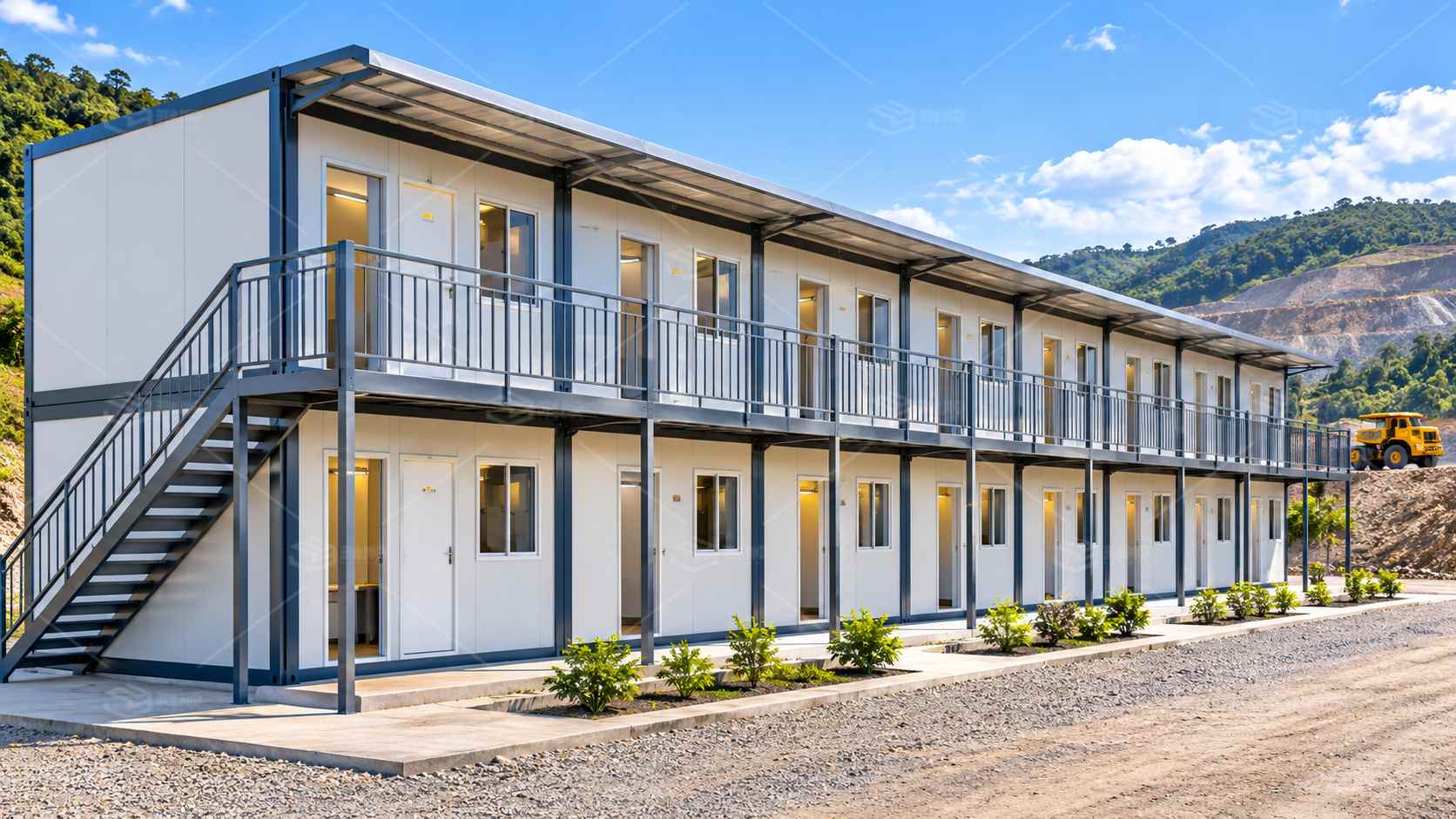
Conceptual illustration of a two-story modular worker dormitory with external staircases and corridors, designed for mining camp accommodation in Indonesia. Not an actual Elang mining project photograph.

YSHUN personnel inspect steel structural components and container loading arrangements for prefabricated building materials, illustrating factory quality control and international shipment preparation.
indonesia-elang-mine-mining-camp-planning
A major copper-gold mining development underway on Indonesia's Sumbawa Island is bringing a previously overlooked issue into the spotlight: Before the mine officially begins production, where will thousands of construction workers, engineers, and operational personnel live, work, and carry out their daily activities?
PT Amman Mineral Nusa Tenggara (AMNT) is advancing the development of the Elang copper-gold mine. Publicly available information indicates that the project's initial investment is estimated at approximately Rp80 trillion, with construction expected to proceed in stages following the completion of environmental impact assessments, engineering design, and other preparatory work.
Elang is considered one of the world's largest undeveloped copper-gold deposits. According to publicly available information from AMMAN, the mine has approximately 2.5 billion tonnes of ore reserves. The project plans to establish a long-distance overland conveyor system connecting Elang with the existing mineral processing, power generation, port, and smelting infrastructure at the Batu Hijau mining complex.
The construction of a large-scale mine generates demand beyond mining equipment, roads, and production facilities. For remote mining operations, worker camps, mining camps, worker accommodation, site offices, and supporting living facilities are also essential infrastructure for maintaining continuous project operations.
A Large Mining Camp Is More Than a Few Dormitories — It Is a Complete Living System
During peak construction periods, large mining projects often need to accommodate thousands of construction workers, equipment installation personnel, and technical specialists.
A complete mining camp therefore typically includes more than worker dormitories. It may also contain management accommodation, project offices, meeting rooms, staff dining halls, kitchens, toilets, shower facilities, laundry rooms, medical clinics, security offices, and communal recreation areas.
As a project transitions from construction to long-term operations, workforce composition and building functions also change.
This means mining camps are better suited to phased planning, with different modular or prefabricated building systems selected according to accommodation capacity, service life, and functional requirements, rather than simply purchasing large numbers of identical buildings.
## Modular Worker Accommodation: A Solution for Large-Scale Mining Camp Housing
Modular worker accommodation is one of the most common applications in mining camps.
Modular worker dormitories can be manufactured in batches using standardized room layouts and equipped with bedrooms, toilets, showers, and basic electrical facilities according to project requirements. For projects involving large workforces, multiple accommodation units can be combined to form complete residential areas, with coordinated planning for internal roads, lighting, water supply, wastewater drainage, and communal living spaces.
Compared with construction carried out entirely on-site, factory prefabrication can reduce the amount of fabrication work required at remote mining locations while helping maintain consistent building quality and construction schedules.
For mines operating on rotational shifts, dormitory design must also consider thermal insulation, ventilation, noise control, pedestrian circulation, and ease of future maintenance.
## K-Type Prefabricated Buildings: Construction Camps and Temporary Offices
K-type prefabricated buildings are particularly suitable for construction phases that require large amounts of building space to be established quickly.
During the early stages of mine development, large numbers of civil engineering contractors, road construction workers, equipment installation teams, and site management personnel typically enter the project.
K-type prefabricated buildings use standardized steel structural components and enclosure materials. Through component-based transportation and on-site assembly, they can be used for centralized worker dormitories, temporary project offices, meeting rooms, and auxiliary construction buildings.
For construction camps with relatively defined service periods and large building quantities, this approach offers considerable flexibility in mass production, transportation planning, and on-site construction.
## T-Type Prefabricated Buildings: Large Dormitories, Staff Dining Halls, and Communal Facilities
T-type prefabricated buildings can be used for larger centralized dormitory areas and communal living facilities.
As the number of construction workers increases, camp requirements gradually shift from simply providing accommodation to establishing a complete range of living facilities.
Staff dining halls, kitchens, communal toilets, shower areas, laundry rooms, lounges, and integrated service spaces all require more carefully planned layouts and circulation routes.
T-type prefabricated buildings can be arranged in connected rows, multi-story configurations, or enclosed layouts according to project plans, making them suitable for large dormitories, dining facilities, and communal living buildings.
Specific structural spans, building heights, occupancy capacities, fire protection measures, and evacuation designs must be determined according to project engineering requirements and applicable local regulations.
## Modular Site Offices: Project Management and Engineering Coordination Spaces
Large mining developments involve multiple teams responsible for mining, civil engineering, road construction, equipment installation, power systems, transportation, safety, and environmental management.
Modular site offices and project management buildings are therefore important components of mining camps.
Modular buildings can be combined as needed to create project manager offices, engineering offices, construction coordination centers, meeting rooms, document storage rooms, and on-site administrative areas.
Certain building structures, wall systems, doors, windows, and interior fittings can be completed in the factory before transportation and installation at the mining site.
For projects with long construction periods and office areas that need to change as construction progresses, future expansion, disassembly, and reconfiguration can also be considered during the design stage.
## Light Steel Buildings: Long-Term Management Offices and Staff Accommodation
As a mine transitions from construction to long-term operations, the requirements for certain buildings also increase.
Light steel buildings can be used for long-term management offices, management staff accommodation, employee activity centers, and other communal facilities intended for continuous use over many years.
Compared with short-term construction camps, these buildings generally require more comprehensive consideration of local wind loads, seismic effects, roof drainage, corrosion protection, thermal insulation, fire safety, and routine maintenance.
For large mining projects, light steel buildings are therefore not simply an upgrade from temporary structures but can form part of the building systems supporting long-term mining operations.
## Large Mining Camps Require Stronger Mass Delivery Capabilities
For mining camps accommodating thousands of people, building procurement is no longer simply a matter of comparing the price of one dormitory or office.
When a project involves dozens or even hundreds of buildings, design development, production planning, material classification, packaging sequences, container loading, and
LINCHENGLONG
Guangdong Yashun Housing Technology Co., Ltd.
yshun@yashunhouse.com
Visit us on social media:
Facebook
YouTube
Legal Disclaimer:
EIN Presswire provides this news content "as is" without warranty of any kind. We do not accept any responsibility or liability for the accuracy, content, images, videos, licenses, completeness, legality, or reliability of the information contained in this article. If you have any complaints or copyright issues related to this article, kindly contact the author above.
